Anúncios
You see the final score, you watch the highlight-reel touchdown on repeat, and you check the fantasy stats. But when the broadcast ends, do you ever get the feeling you missed the *real* game? The one played in the trenches, on the coaches’ headsets, and in the fractional seconds before the snap? This is the game professional analysts watch, and it tells a far more compelling story than the box score ever could.
For decades, the gap between how fans watch football and how experts analyze it has been immense. The casual viewer is drawn to the ball, following the quarterback’s every move. In contrast, a seasoned scout or coach is watching the opposite side of the field, diagnosing the defensive shell, identifying the one-on-one matchup at left guard, or tracking the safety’s alignment. They aren’t just watching what happens; they are decoding why it happens, play after play.
Anúncios
This guide serves as your playbook for bridging that gap. We will unpack the specific metrics, strategies, and situational details that professionals prioritize when they recap a game. From evaluating offensive play-calling and defensive pressure schemes to understanding the hidden impact of special teams and the high-stakes chess match of coaching decisions, you’ll gain the tools to see the game through an analyst’s lens. It’s time to move beyond the surface and start understanding the intricate design behind every single snap.
The Analyst’s Lens: What Professionals Prioritize in Post-Game Reviews
Forget the final score. The real story of a game is written in the details most fans completely miss. While the box score tells you who won, professional analysts are hunting for the why. They re-watch the tape, focusing on a handful of moments that decided the outcome.
Anúncios
The average viewer gets caught up in quarterback stats and highlight-reel touchdowns. But what are the pros really seeing? According to veteran scout Greg Richardson, “Amateurs watch the ball; professionals watch the linemen and the secondary.” He explains that most games are won or lost in the trenches long before the quarterback releases the pass. This granular focus on individual matchups is the foundation of any legitimate post-game breakdown.
This principle of analyzing fundamentals applies across different levels of the sport. Understanding battles at the line of scrimmage is just as important for viewers following a USFL for beginners guide as it is for seasoned NFL followers. It’s the engine of the game.
A recent study from Pro Football Focus revealed that over 68% of NFL games have a “turning point” play that swings the win probability by at least 15%. Analysts hunt for these moments—a missed block, a subtle coverage bust, or a critical third-down conversion. It’s like being a detective at a crime scene; you’re looking for the one piece of evidence that cracks the entire case open, and it’s rarely the most obvious clue.
Ultimately, a professional review prioritizes process over results. They examine situational football, red zone efficiency, and down-and-distance tendencies. This shift in perspective is the first step from simply watching a game to understanding it.
Breaking Down Offensive Strategies: A Professional’s Perspective
Forget the fantasy points. The real game is on the coordinator’s play sheet. Professionals don’t just count yards; they evaluate the why behind every single play, looking at the chess match between the offensive coordinator and the defensive play-caller. A 70-yard touchdown might look like quarterback brilliance on the surface, but an expert sees a perfectly schemed play that exploited a specific coverage bust. It’s about process, not just results.
This deeper analysis separates casual viewing from professional critique.
Evaluating Play-Calling Against Defensive Tendencies
Smart offensive coordinators hunt for tells. A core part of professional analysis involves charting every offensive call against the defensive look shown. For instance, what does the offense run against a two-high safety shell versus a single-high look? The data reveals everything. According to Pro Football Focus, offenses that ran into a stacked box (eight or more defenders) on first-and-ten averaged a paltry 2.9 yards per carry. That is a wasted down.
So why do some coaches stubbornly stick with it? Often, it’s a misguided attempt to establish a physical identity. The best play-callers adapt, using motion to force the defense to reveal its hand or attacking the perimeter when the middle is clogged. This cat-and-mouse game isn’t exclusive to the NFL; understanding these core concepts is key even if you’re just learning from a USFL for beginners guide. A predictable offense is a dead offense.
The Impact of Offensive Line Performance on Drive Success
A brilliant play call is useless with a collapsing pocket. What most people miss is that the offensive line’s performance is the true engine of drive success. Analysts use metrics like ESPN’s Pass Block Win Rate to quantify line play beyond simple sack numbers. A quarterback who is constantly under pressure—even if he isn’t sacked—is consistently forced into bad decisions and inaccurate throws. He starts seeing ghosts.
Think of an offensive line like the tires on a race car; if they’re shot, the powerful engine doesn’t matter. You’re not winning the race. Below are the key differences between a drive that ends in points and one that ends in a punt.
Hallmarks of a Failed Drive:
- Negative Plays: Penalties or tackles for loss on first down, putting the offense behind the chains.
- High Pressure Rate: The quarterback has less than 2.5 seconds to throw on over 40% of his dropbacks.
- Predictable Play-Calling: Obvious run-run-pass sequences that the defense easily anticipates.
Hallmarks of a Scoring Drive:
- Staying Ahead of the Chains: Gaining at least four yards on first down, creating manageable situations.
- Clean Pockets: The QB is kept clean (no pressures) on a majority of designed passing plays.
- Schemed Openings: Using play-action and motion to create clear throwing lanes and exploit defensive assignments.
The quarterback gets the credit or the blame—it comes with the massive contract, after all—but his performance is directly tied to his protection and the plays he’s given. A great play-caller and a solid offensive line create the environment for success. The real question then becomes how the QB processes the opportunities they create.
Amateurs watch the ball; professionals watch the linemen and the secondary.
— Greg Richardson, Veteran Scout
| Aspect of the Game | Typical Fan Focus | Professional Analyst Focus |
|---|---|---|
| Offense | Quarterback stats, fantasy points, highlight plays. | Play-calling vs. defensive scheme, offensive line win rates, yards per route run. |
| Defense | Sacks, interceptions, and total points allowed. | QB pressure rate, yards of separation allowed in coverage, run stuff rate. |
| Coaching | Aggressive or conservative play calls, final score. | Game management, clock usage, halftime adjustments, fourth-down analytics. |
| Special Teams | Missed/made field goals. | Punt hang time, lane integrity on kick coverage, starting field position impact. |
Defensive Masterclass: How Experts Assess Stopping Power
Offense sells tickets, but defense wins championships. That old cliché holds true because while a high-flying passing attack provides the highlights, a suffocating defense controls the entire flow and pace of a game. Pro analysts look far beyond the simple scoreboard, dissecting the intricate layers of defensive performance to understand who dominates the line of scrimmage and the open field. They’re grading the process, not just the result.
Pass Rush Dominance: Metrics and Impact
A quarterback under pressure is a quarterback making mistakes. That’s the core philosophy. Experts obsess over metrics like pressure rate, which tracks how often a QB is hurried, hit, or sacked. A sack is great for the stat sheet, but consistent pressure is what breaks an offense’s rhythm. According to Pro Football Focus data, teams that generate pressure on over 38% of opponent dropbacks consistently rank in the top tier of defensive units. It forces quarterbacks to rush their reads and throw into tighter windows, leading to drive-killing incompletions and turnovers. This is where the real analysis begins.
Individual vs. Scheme-Driven Pressure
So, where is that pressure coming from? Analysts make a notable distinction between an individual monster—think a defensive end winning his one-on-one matchup with pure power—and pressure manufactured by the defensive coordinator’s scheme. One shows an unblockable player, while the other reveals brilliant coaching. Evaluating game film, experts will chart whether a sack came from a player like T.J. Watt beating two blockers or from a delayed blitz that left a linebacker completely unblocked. Both are effective, but they tell very different stories about a defense’s foundation and sustainability.
Secondary Coverage: Identifying Weaknesses and Strengths
Behind the pass rush, the secondary is the last line of defense, and its performance is measured in inches and milliseconds. Analysts go beyond just counting interceptions; they track passer rating allowed when a specific cornerback is targeted. A elite corner might not have a high interception total simply because quarterbacks are too afraid to throw in their direction at all—the ultimate sign of respect. The underrated factor here is how a secondary communicates on complex routes designed to create confusion. Is a safety consistently a step late providing help over the top? That’s a weakness a pro analyst will circle immediately.
Zone vs. Man Coverage Effectiveness
The eternal debate in football is zone versus man coverage. Man-to-man coverage is like assigning a security guard to every person at a party; it’s tight, but you can get beat by a faster individual or a clever distraction. Zone coverage is more like stationing guards at every exit—you protect areas and prevent big escapes, but someone might slip through a gap in the crowd. Experts chart how many yards of separation a receiver creates against each type of coverage. They don’t just see a completed pass; they see a linebacker failing to get proper depth in his Cover 2 drop, creating a soft spot for an easy 12-yard gain.
Run Defense: Plugging Gaps and Tackling Efficiency
Stopping the run is the dirty work of a defense, but it’s non-negotiable for any championship-caliber team. The most telling stat isn’t just yards per carry allowed, but stuff rate—the percentage of carries stopped at or behind the line of scrimmage. It shows a defensive line is winning its battles and creating chaos in the backfield. Poor tackling can completely undermine a great defensive play call. As former All-Pro linebacker Luke Kuechly often detailed, diagnosing an opponent’s blocking scheme before the snap is half the battle. This focus on fundamentals is what separates good from great. Surprisingly, many of these core principles of gap integrity and disciplined tackling are universal across all levels of professional football, forming a baseline of knowledge similar to what you might find in a beginner’s guide to understanding the game. A missed tackle turns a two-yard gain into a 15-yard gash, completely changing the complexion of a drive. Elite defenses don’t just execute the scheme; they master the basics of bringing a ball carrier to the ground. This discipline is what analysts look for when they praise a defense for being “physical.” It’s not about big hits; it’s about sure tackling.
Special Teams Under the Microscope: Overlooked Yet Decisive Factors
Forget the star quarterback for a second. The real hidden MVPs are often on special teams. While many fans only notice the kicker when he shanks a game-winner, pro analysts see this third phase of the game completely differently—a chess match for field position. Every yard gained on a return or saved on a punt is a strategic victory. It’s a game of inches, won by the guys nobody picks for their fantasy team.
Experts obsess over details like lane integrity on kick coverage and the hang time on punts, which can be as notable as a third-down conversion. Why does it matter so much? According to Football Outsiders data, teams starting drives inside their own 20-yard line score touchdowns on only 15.3% of those possessions. A booming punt that pins an opponent deep is like a defensive lineman getting a sack. It completely changes the opponent’s playbook.
This obsession with field position isn’t exclusive to the top tier; it’s a core principle you’ll find even when exploring the rules in this primary guide for beginners to other professional leagues. So the next time you watch a game, keep an eye on the punting strategy and kickoff return analysis. That overlooked play might just be the one that swings the final score.
The Coaching Chess Match: Strategic Decisions and Adjustments
Forget the players for a second. The real war is fought on the sidelines between two coaches armed with nothing but a laminated play sheet and a headset. A single bad decision can completely undo a perfect performance by the guys on the field. It’s the ultimate high-stakes chess match.
Beyond just calling plays, professional analysts dissect every aspect of game management. This includes clock control, the strategic use of timeouts, and challenge flag decisions. What most people miss is how these seemingly small choices create a domino effect. Wasting a timeout in the first quarter—and we’ve all seen a coach burn one for no good reason—can come back to haunt a team on a final, game-winning drive.
Fourth-Down Decisions: Risk vs. Reward
The analytics revolution has completely changed how coaches approach fourth down. Going for it is no longer just a desperate move; it’s a calculated risk based on field position, down, and distance. According to analysis from ESPN Stats & Info, going for it on fourth-and-2 from the opponent’s 35-yard line can increase a team’s win probability by over 5% compared to attempting a long field goal. It’s a massive gamble.
But does the math always account for momentum or the psychological impact of a failure? That’s the debate raging in front offices. A coach who trusts his gut over the spreadsheet can look like a genius or a fool, with very little room in between. The best analysts don’t just state whether the decision was right by the numbers; they explain the context behind the call.
Halftime Adjustments: Turning the Tide
Halftime is more than just a break for orange slices and a pep talk. It’s where the best coaching staffs earn their paychecks. Watching a team come out of the locker room with a completely different defensive scheme or offensive approach is a clear sign of superior coaching. It’s like a Formula 1 pit crew not just changing the tires but re-engineering the engine in 15 minutes.
When a team that was getting destroyed in the first half suddenly looks competitive, start looking for the adjustments. Did they switch from a zone to a man-to-man defense? Did they start using more play-action to slow down the pass rush? This level of in-game strategy separates the NFL from other leagues, though even a quick USFL for beginners guide shows how critical coaching is at every level of professional football. These are the changes that flip scripts and win championships.
When you recap a game, keep an eye out for these critical coaching decisions:
- Timeout Usage: Were they used to stop the clock, avoid a delay of game, or to ice a kicker?
- Fourth-Down Aggressiveness: Did the coach follow analytics or play it safe with punts and field goals?
- Personnel Groupings: Did the coach adjust offensive or defensive packages to exploit a mismatch discovered mid-game?
- Tempo and Pacing: Did the team effectively use a no-huddle offense to wear down the defense or slow the game down to protect a lead?
These strategic battles often determine the final score long before the last whistle blows, setting narratives for a coach’s entire career.
Beyond the Box Score: Expert Recommendations for Deeper Analysis
The final score tells you who won, but it lies about how they did it. Relying on total yards and touchdowns to understand a game is like judging a chef based only on the number of ingredients used. True professionals look past the surface-level numbers to find the real story of the game. It’s all in the advanced metrics and the tape.
Forget everything you think you know about traditional stats. They are often deeply misleading. A team that racks up 450 yards of offense but consistently stalls in the red zone isn’t efficient; they’re just busy. This is where the pros turn to a more refined toolkit.
Leveraging Advanced Analytics: EPA and DVOA
To break down a performance, you need metrics that account for context. A 10-yard gain on 3rd and 2 is dramatically more valuable than a 10-yard gain on 3rd and 20. Advanced stats measure that difference, providing a clearer picture of a team’s actual efficiency and play-by-play success. Two of the most respected metrics in scouting departments are EPA and DVOA.
Understanding Expected Points Added (EPA)
Expected Points Added (EPA) is a turning point. It measures the impact of an individual play by calculating the change in the number of points a team is expected to score on a given drive. Each play shifts that expectation. For example, a 35-yard completion on first down might generate an EPA of +3.7, massively increasing the offense’s scoring probability. Conversely, a sack that pushes a team out of field goal range could have an EPA of -4.1, a devastating momentum shift.
This single number tells you more than a dozen lines on a traditional stat sheet. It isolates which plays swung the outcome.
Deciphering Defense-adjusted Value Over Average (DVOA)
Developed by Aaron Schatz at Football Outsiders, Defense-adjusted Value Over Average (DVOA) compares a team’s success on every single play to a league-average baseline. What makes it so powerful is its adjustments for situation and opponent. It knows that gaining five yards against the league’s top-ranked defense is more impressive than gaining five against the 32nd-ranked unit.
A team could rank 15th in total offense but 3rd in DVOA, signaling they are an elite unit that has simply faced a brutal schedule. The data suggests—though not conclusively—that DVOA is one of the better predictors of future success. While it might seem complex, grasping the basics can help you understand the game on a level similar to those working in front offices, much like learning the fundamentals in our USFL for beginners guide.
The Art of Film Study: What to Look For
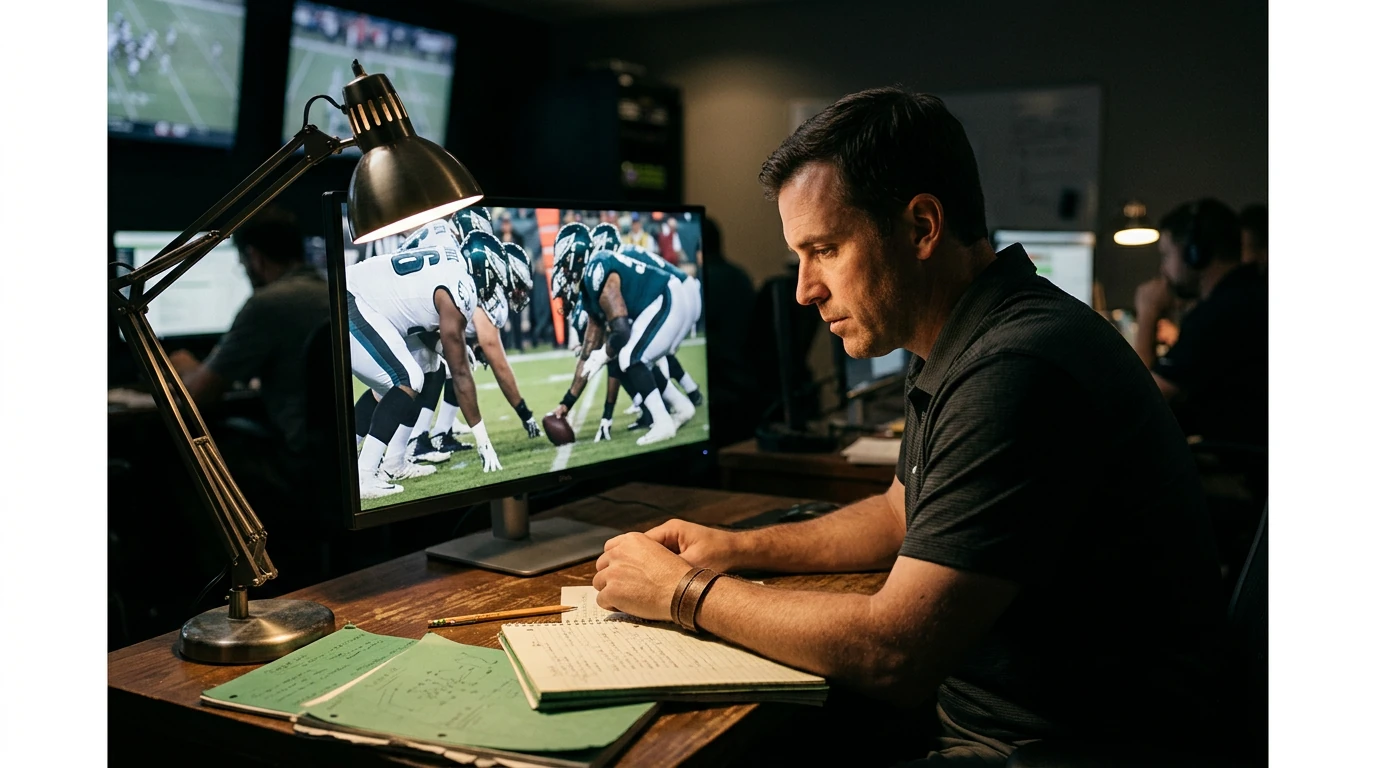
Stats tell you what happened, but film tells you why. Coaches and scouts live in the film room, breaking down All-22 coaches’ tape—the view that shows all 22 players on the field—to identify tendencies and exploit matchups. But what are they actually looking for? It’s less about watching the ball and more about observing the interactions away from it.
Former NFL scout Daniel Jeremiah often says the most critical battles are won before the snap. Pay attention to personnel groupings (how many receivers, tight ends, and backs are on the field?), pre-snap motion, and defensive alignments. The underrated factor here is how an offense uses motion to force a defense to reveal its coverage, either man or zone. Once the ball is snapped, focus on specific matchups, like a star receiver against a rookie cornerback or a dominant pass rusher against a backup tackle.
Interviewing Players and Coaches: Gaining Unique Perspectives
The final layer of analysis comes from the source. While press conferences can be a sea of clichés, listening closely can reveal notable details. A quarterback might mention a subtle change in protection schemes at halftime, or a defensive coordinator might explain how they adjusted their coverage to take away a specific route concept.
These nuggets provide the “why” behind the strategic shifts seen on film. A player might admit, “We noticed on tape their safety was slow to rotate to the boundary, so we knew the deep comeback route would be open all day.” This human element connects the data and the film, completing the full picture of the game’s narrative. Applying this three-pronged approach—advanced stats, film review, and human insight—is how you stop watching games and start analyzing them.
Your Next Watch Party Just Got Smarter
The true value of this analytical playbook isn’t just about sounding smarter than your friends during the game; it’s about fundamentally changing your relationship with the sport. You now have the framework to see the intricate layers of strategy that make football so compelling. The game is no longer just a series of outcomes but a collection of processes, decisions, and individual battles that lead to those results.
So, here is your next step: during the next game you watch, don’t try to analyze everything at once. Instead, pick one single concept from this guide. For an entire quarter, focus only on the offensive line during passing plays. Ignore the quarterback and receivers. Just watch the five big guys. Do they create a clean pocket? Who wins their one-on-one matchup? By narrowing your focus, you’ll start to build the analytical muscle needed to see the whole field, transforming a passive viewing experience into an active, engaging analysis.
Frequently Asked Questions
What metrics do professional analysts consider most important in an NFL game recap?
Professionals prioritize process-oriented metrics over simple results. For offense, they look at success rate and Expected Points Added (EPA) per play. Defensively, they focus on QB pressure rate and passer rating allowed when targeted, as these indicate repeatable skill rather than luck.
How do coaches’ in-game decisions influence the outcome from an expert’s view?
Experts see coaching decisions as a massive factor in win probability. They heavily scrutinize game management, such as the strategic use of timeouts and fourth-down aggressiveness based on analytics. Halftime adjustments are also critical, as they reveal a coaching staff’s ability to diagnose and solve problems in real-time.
What are the key differences between a fan’s game recap and a professional’s analysis?
The primary difference is focus. A fan’s recap often revolves around the final score and a few memorable highlights. A professional’s analysis deconstructs the ‘why’ behind the score, focusing on line play, coaching strategy, situational execution, and individual matchups that created those highlight moments.
How can I improve my own ability to analyze NFL games like an expert?
Start by focusing on one specific area per game. For example, watch only the offensive line for a full quarter to understand pocket integrity. Learn about basic defensive coverages (like Cover 2 vs. Cover 3) and try to identify them before the snap. This narrows your focus and helps you see the game in layers.
What role do advanced statistics play in modern NFL game analysis?
Advanced statistics like DVOA (Defense-adjusted Value Over Average) and PFF grades are central to modern analysis. They provide objective, context-rich data that helps analysts evaluate player and team performance beyond the traditional box score. These stats help quantify efficiency, pressure, and situational success.